
Muse Yuko Kudo: Artist, Storyteller, Human Connector
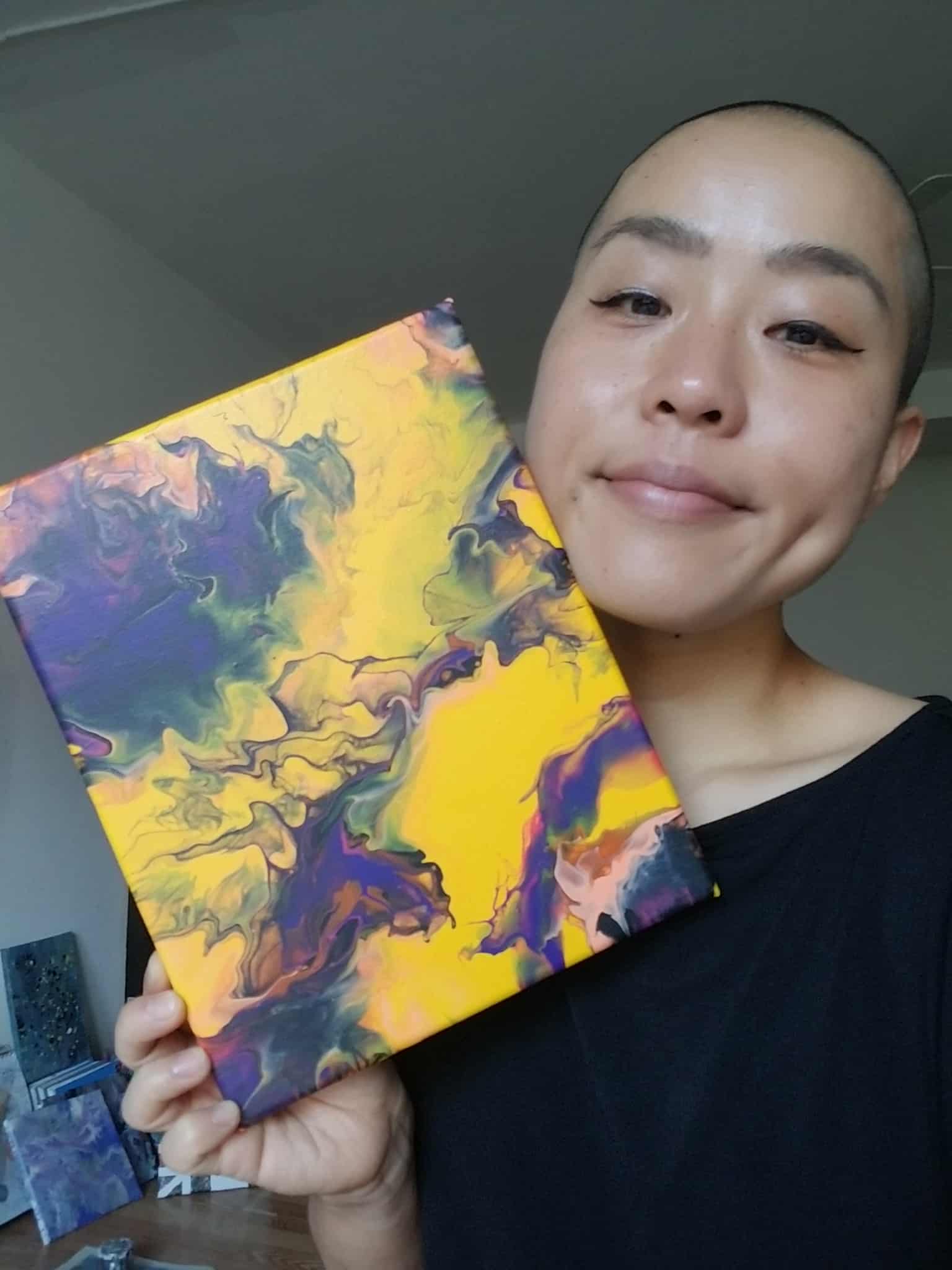
We first met Yuko Kudo during our very first business venture in 2017, and she quickly became a vital part of our community. Her spirit was infectious, her joy undeniable, and her presence unforgettable. Over the years, we’ve watched her navigate life’s challenges with courage and creativity, and her recent experiences, surviving life-changing health events and discovering a deeper perception of self are profoundly inspiring. Yuko reminds us that, the only thing that truly matters is love.
DCG: Your life has asked you to begin again more than once. After surviving experiences that changed you physically, emotionally, and spiritually, how did your relationship with life and with yourself shift in ways that directly shaped the work you do today?
YK: My first love was theatre and acting, so reinventing self or the idea of beginning again, is not something that is unfamiliar. Of course, playing different roles as an actor was much easier, because it was clear that the process was temporary. That being said, wearing different hats as an artist and entrepreneur can be a very similar process. Each hat teaches you different skillsets and mindsets that are applicable to other projects. Over the course of years, I came to embrace those changes as seasons of life. Because we are always changing. Those are the spiritual and emotional parts of my answer.
For people who are not familiar with my story, I had a brain aneurysm that ruptured in June, 2024. I spent two weeks in the ICU. And at the end of 2025, I was treated for another aneurysm thankfully before it ruptured. Surviving two brain aneurysms showed me how disconnected I had been from myself without realizing. I experienced a severe case of identity crisis. I’m so grateful to be here, but I have to admit that it has been challenging. Because from outside, I look “just fine”, for the most part. Many symptoms of brain injury can often be invisible from outside (Invisible injury). It required me to scale down on “crowd” related work, such as events, filmsets, large gatherings; things that people have known me for. As a part of my healing process, I started painting. I started right after I came back from the hospital and I’ve been painting since then. I have a whole new appreciation and approach for art practice as a recipient of its healing power, which is now the direction that I want to head towards. I am excited to cultivate the space for love and kindness, assisting people to feel wholeness within, and engaging art as a tool for community wellness.
DCG: You often say that art is a language that speaks human. When did you realize that your creativity wasn’t just expression, but communication, especially in moments when words failed you?
YK: Thank you for bringing this up. I believe that everyone is an artist in our own way. We doodle, make sounds, move around… it’s in our human nature. And “art” facilitates the connection between us. I create because I want to connect with people. Growing up as an awkward child in a small town in Japan, who often felt like a misfit, I knew the power of art instinctively. There are tons of stories that I can share with you. But, I’m just going to share an excerpt from my show
Art translates what I have yet to understand, because it shows us our humanity.
I see the story through your photography, even when I don’t speak your language.
I can feel what you are feeling through your dance, even when I don’t understand your experience.
I may not have the words to describe what I’m feeling right now, but I know that your poetry sees me.
I may not have the strength to continue right now, but your music tells me that I’m not alone.
I’m afraid to face the deep wounds in my heart, but creating this show allows me to heal and share my healing journey with you.
Art is a language that speaks to our heart.
Art is a language that speaks human.
– Excerpt from “I Came Here To Be Love” –
We see ourselves in each other, the story, or the world. There’s no need to explain in words, because we feel it. I think that connection is what we seek as humans. Art gives us a chance to remember that we are here.
DCG: Leaving Japan and building a creative life across cultures takes courage. What did that transition teach you about identity, belonging, and the courage it takes to be seen?
YK: During the holiday season just past, I went to a multi-cultural holiday event ( Hosted by I Am Perspective) and someone said “My culture is a culture of LOVE”. I love that frame of thinking, because no matter where we are from, the desire to be loved, to belong and to connect that’s what we share as human nature. The last 20 plus years in the United States, 10 years in LA and 12 years in NY, have taught me so much about who I am and what belonging means. By meeting new people and learning about the new city, the definition evolved as well. For a long time, I often saw myself as an outsider trying so hard to fit in. And being an actor really gave me great tools, like reading the room, navigating different communication styles and anticipating the people’s needs and wants. That was a great starting point. But I wanted more than that.
A lot of my work in the past specifically focused on this theme of identity and belongings because I understand what it feels like NOT TO BELONG and DESIRE that sense of belonging. “I AM” Series (Monthly Open Mic Series), Untapped Storytellers (Short Documentary Series), Dear Asian Girls (Documentary Film), I Came Here to Be Love (Digital hybrid solo show). Creating these works have taught me so much not only about who I am but how we, humans, all share similar feelings and desires. Which goes back to the point in the previous topic “Art is a language that speaks human”.
Having said that, I want to touch on the next part “courage it takes to be seen”. There are differences between being visible and being seen. And to add to that, the feeling of being seen as who you are as a person and getting validation are also different. Making ourselves visible became so easy nowadays because of technology. For many artists, creatives and entrepreneurs, the line between personal/private life and professional life became very nuanced. It takes an enormous amount of emotional and mental work to find the rooted place. What’s been helpful for me, especially after the brain injury, is to check in how connected I am to myself first. Then, the next question would be “Who/what am I trying to connect with right now?” Because more often than not looking at yourself deep in the mirror requires us to be courageous the most.
Audre Lorde said. “If I didn’t define myself for myself, I would be crunched into other people’s fantasies for me and eaten alive.” So this is my long winded way of saying, this whole journey has been about learning to love myself and others for the wholeness of who we are, no matter where we are.
DCG: Your work holds grief, love, survival, and joy at the same time. What is a personal truth you once kept quiet, but now intentionally share through your art, storytelling, and community spaces?
YK: I do put a lot of my personal stories in my work. The three solo shows that I’ve created in the past, Home My Heart, Goodbye Love, I Came Here To Be Love, all rehearsals started with the ugly cries. Writing is a powerful form of art that’s so therapeutic. We get to take out what’s in our head, all the messiness and delusions, on paper and restructure the story that empowers us. I am so grateful to have an incredible creative team who helped me make that happen, and an audience who gave me the space to be courageous. My story is a story of an immigrant woman, a story of a person who navigated a difficult relationship with mother growing up, a story of a relationship that had difficult challenges, a story of having an abortion and experiencing financial struggles… I have everything to share, nothing to prove. Theatres are healing because people can see themselves in these stories and start the healing journey of their own.
Right now, my aneurysm experience is one of the main things that I share. 1 in 50 people in America has a UNruptured brain aneurysm. 1 in 50! I was one of the “lucky ones” that made it to the hospital and I am still here. It’s one thing to be on the look out for what you can see. But what about things like aneurysms that you can’t see from the outside? We need wellness care and preventive care, instead of treating the symptoms. In addition to that I’ve been sharing how much art has helped me during the recovery. It truly was a mindfulness practice. Because sometimes you don’t want to participate in the support group or to talk about how you don’t feel like yourself any more. So that’s the space I want to cultivate for the community moving forward, a place of love, kindness and connection.
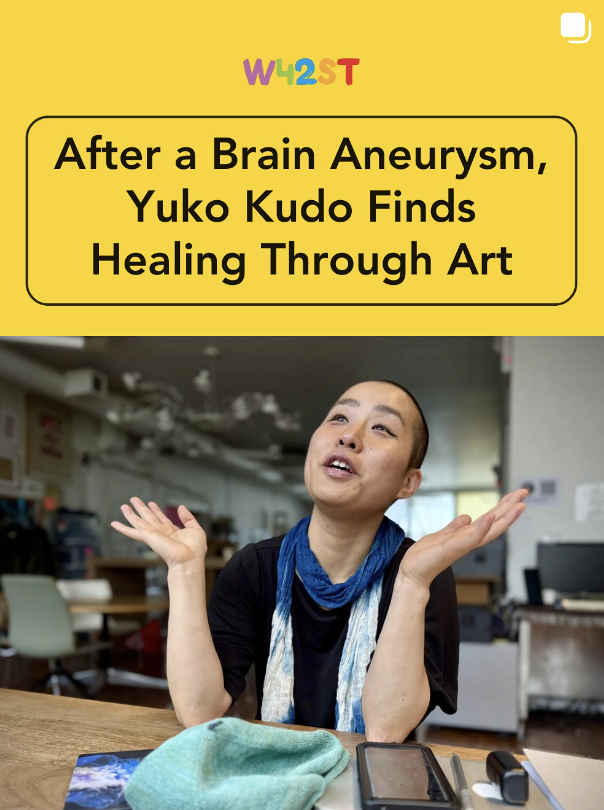
DCG: For those discovering you for the first time: how do you describe what you do today?
What types of work, collaborations, or experiences do you offer and who do you feel most called to serve through Yuko Is Love Live Life?
YK: I do healing work to bring more love and kindness to the world. “Yuko is Love+Live+Life” that was rooted in my wish for all of us to Love and Live your Life. Which is still there, but I’m in a chapter of “Braver Love” and “Wholeness”. We need more love and kindness in this world. I do this work through my art and creative work, by convening with people, by looking at the way we do things differently especially business & economics.
DCG: You create spaces where people feel deeply seen and safe to share their stories. What does holding space mean to you, and how do you protect your own heart while supporting others?
YK: I appreciate you for asking this question. Holding space, to me, is about nurturing relationships and I try to remember not to exclude myself, especially when it’s a group setting. “This is a safe/brave space” or “let’s leave the judgement at the door” are great places to start, but if people don’t feel it, it’s just empty words. “How can we connect as humans first?” That’s the question that I come back to all the time. There are many people who feel tokenized, feel pressured to represent certain groups or demographics, or feel exploited even. Whether you’re hosting an event, doing a podcast interview, or interviewing for a blog/vlog, relationships as foundation needs to be there. So, making sure that I’m entering the space fully present is my responsibility. Because relationships go both ways. Which is a great transition to the second part of your question.
I have to admit that I am grateful for my aneurysm, because I am learning so much about taking care of myself. I am cognizant of my energy level, both physically and emotionally, what it takes to hold space for people and what it takes for me to recover if I’m doing an event or filming. Relationships are connection and energy exchange, which takes form in many ways. I am committed to be fully present in that space so that the energy I’m exchanging with people is rooted in love, kindness and generosity. And this is a great reminder for those of us who love what we do because feelings of burnout, deprivation or even resentment can sneak up on you very easily if we are not paying attention. This doesn’t mean ignoring the different seasons and needs in our life. But it is important to pay attention to our wellbeing simultaneously. Let’s remind ourselves to hydrate, to rest well and nourish ourselves. So that we can truly embrace the gift of connection and what’s being created in space.
DCG: Some of your most meaningful work has come from moments of uncertainty or pain. How do you transform fear, loneliness, or doubt into creative fuel without bypassing the emotion itself?
YK: It’s different every time. Because each experience is there to teach us something different. An artist friend of mine and I had a great conversation the other day about the strength we have built by being an artist. The last few years have been especially tough for artists, cultural workers and people in the entertainment industry. We were talking about how volatile everything is nowadays in the art and entertainment industry, particularly AI and government grants. But what we realized was how resilient we’ve become by choosing this path in art. And a lot of that has nothing to do with who we are as an artist or our talent. It doesn’t mean that we are not good or we don’t deserve it.
I remember the time that I couldn’t even audition for a role because I was not born in America. I remember feeling resentful for my friends who booked the jobs because that meant I didn’t get the part and on top of that I hated myself for not being able to be happy for my friends. This path has taught us not to be consumed by uncertainty or pain. We still feel all of that. But instead of wallowing in it, we have learned to see things differently. “It’s either this, or something better.” I learned that from Natalie Roy and Kristien Hanggi. We cannot control the outcome, but what we have in control is how we show up for what we love. This is a great lesson that we can apply for anything.
DCG: There’s a quiet bravery in choosing love and kindness again and again. On the days when life tests that choice, what practices or truths bring you back to yourself?
YK: Right now, I just have to remind myself that I could have been dead when my aneurysm ruptured. But I am still here. I am still here to be LOVE.
DCG: When someone experiences your work, whether through art, conversation, or collaboration, what do you hope shifts inside them? Not what they learn, but what they feel.
YK: I want people to feel seen, heard and loved. And feel hopeful.
DCG: As you look toward the future, what legacy are you consciously building? Not in achievements or visibility, but in the emotional imprint you leave on the people who cross your path.
YK: I agree with what Maya Angelous said “You have no idea what your legacy will be. Your legacy is what you do every day. Your legacy is every life you’ve ever touched, every person whose life was either moved or not. It’s every person you’ve harmed or helped. That’s your legacy.” So all I can do is to show up with love and kindness no matter what.
Collaborate with Yuko Kudo here

Be the first to comment